After Game 10, Deadlink changed.
Not in the sudden chaos of a bloodier map or a deadlier monster.
But in what it revealed.
Because Deadlink wasn’t just a match-based bloodsport anymore. It wasn’t chaos for chaos’ sake. It was structure—a towering, brutal system built for control.
One hundred floors. A vertical world.
Each level a gauntlet, a world of its own—crafted to test, isolate, and reduce. But patterns had started to emerge, and for those who survived the early hell, the truth became visible.
Every five floors came a Safe Zone—places encased in invisible barriers. Temporary refuge. You could eat. Heal. Trade. But even those havens carried weight. You couldn’t stay forever. And everyone knew: safety was always rented, never owned.
At every thirtieth floor, everything shifted.
Floors 30, 60, and 90 weren’t just new challenges. They were filters. Purpose-built Dungeon Blocks sat there—zones designed to break the strongest, to weed out the rest. The survivors called them execution chambers with puzzles.
And they weren’t wrong.
Players whispered of it constantly now. If you wanted to live, you needed Blings. The currency that bought everything: weapons, food, beds, breathing room. It wasn’t just economy. It was oxygen.
Some players PK’d for them. Quietly. Strategically. You never knew who would vanish in the next floor drop.
No one knew who ran it.
No one had seen an Admin.
And death was permanent.
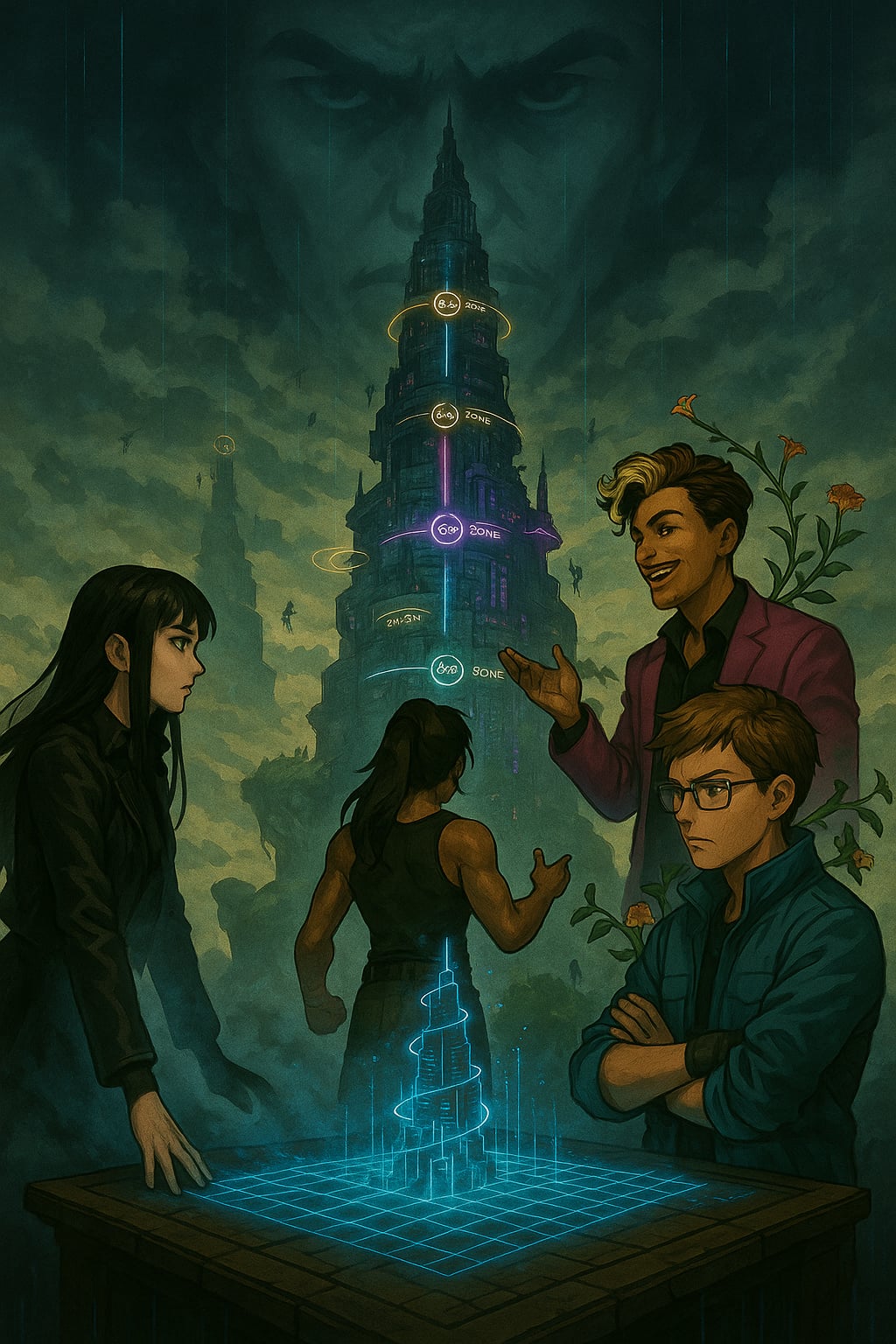
They gathered in a side room off the Safe Zone on Floor 11. Four of them. The war-room atmosphere was unofficial—but real.
A conjured map hovered above a projection plate in the center, flickering with neon-blue light. Floor scans. Resource data. Death percentages. A whole tower of numbers and blood.
Gerbert stood near the projection, focused on its grid lines. His eyes twitched behind his glasses, flicking between paths, probability notes, and density curves.
“Each floor has its own algorithm,” he said. “The Safe Zones are self-contained, but they’re temporary. Everything else keeps shifting. Traps, enemy types, terrain.”
Taan crouched nearby, arms resting on her knees. “We’re not meant to climb,” she said. “We’re meant to die before we see what’s above.”
She pointed at the overlay for Floor 30’s Dungeon Block. It was marked in crimson. “And this? That’s not difficulty. That’s execution.”
Rann stood with her back to the wall, arms crossed, face blank. Her voice, when it came, was sharp enough to cut air.
“This isn’t a game anymore. It’s a hierarchy. Every floor is a screen. A stage. A punishment.”
Gerbert didn’t look away from the display. “And someone’s watching.”
Taan didn’t hesitate. “We’ll get to them.”
From the far corner, Ace lounged on a slanted bench, vines curled lazily around his fingers. His coat was draped over one shoulder, hair tousled, expression calm—but his eyes were sharp.
“Darlings,” he said, voice melodic, “they’ve built a tower for monsters. What they didn’t expect…” He sat up. “...was for the monsters to get smart.”
Rann raised an eyebrow. “You mean us?”
“Obviously,” Ace grinned. “We’re dangerous. We just need to stop acting like prey.”
Gerbert leaned back, his conjured notes collapsing into neat digital folders. “There’s more than one way to play this.”
Taan stood, unfolding like a spring. Her limbs moved with a subtle tension—restrained strength. “And we don’t have to play it their way.”
Ace stood next, stretching like a cat. “No, but if we’re going to climb their cursed tower, I’d like to make it look fabulous.”
No one laughed.
But no one argued.
They turned toward the hallway exit. The floor assignment had just pinged.
Gerbert closed the interface.
Rann cracked her neck.
Taan flexed her bandaged hands.
Ace sighed theatrically, stood, and spun his coat into place.
No one said a word.
But when the door opened—every step forward meant something.
The next floor awaited.
And this time, they understood the rules. Which meant they could break them.